Learn how monitoring exposed credentials and breach data can help businesses identify account risks and respond when company information appears outside its intended environment.
Dark web monitoring services for businesses help identify signs that company email addresses, usernames, passwords, or other information may have appeared in known data breaches or underground sources.
Finding exposed information does not necessarily mean someone has already accessed your business systems. However, it can provide an early warning that a password, email address, or other credential should be reviewed before someone attempts to misuse it.
Why Stolen Credentials Matter to Businesses
Employees use usernames and passwords to access email, cloud applications, customer systems, remote services, and other business resources every day.
If those credentials appear in a breach, they may eventually be shared, resold, or reused elsewhere. As a result, businesses need a way to recognize credential exposure and respond appropriately.
What Is the Dark Web?
The dark web refers to internet services that are not indexed in the same way as ordinary websites and often require specialized software or configurations to access.
Although the dark web has legitimate uses, criminal marketplaces and forums may also use it to exchange stolen information, credentials, documents, malware, and access to compromised systems.
Recent reporting provides a practical example. In September 2026, Reuters reported that the FBI was investigating a large collection of identity documents that had reportedly been offered through a dark-web marketplace. The incident shows how stolen information can move beyond the organization where it was originally collected. Read the Reuters report on the dark-web data exposure .
What Is Dark Web Monitoring?
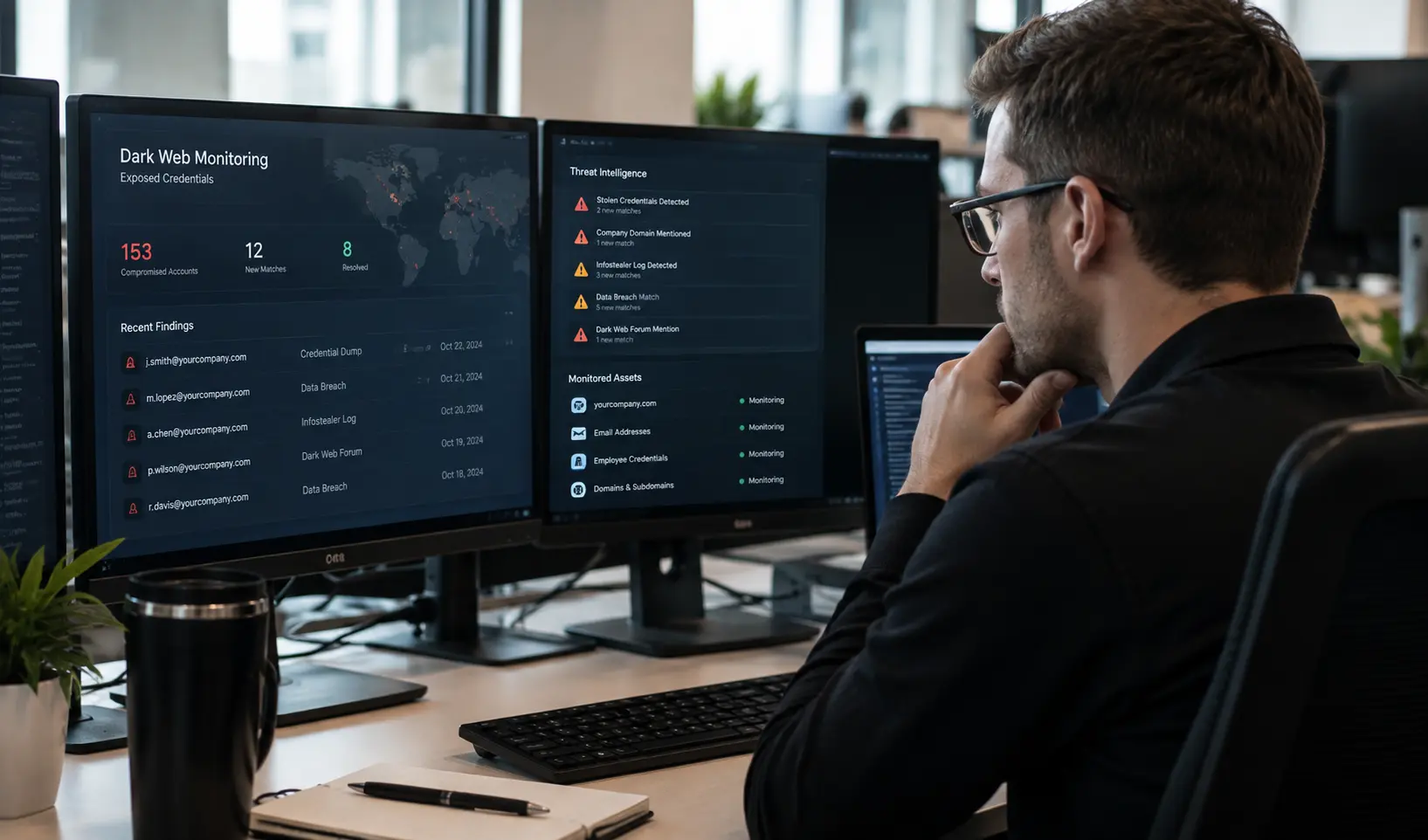
Dark web monitoring is the process of checking breach data, credential collections, and other monitored sources for information associated with a person or organization.
Depending on the service, monitoring may look for:
- Business email addresses
- Usernames
- Exposed passwords or password hashes
- Company domains
- Phone numbers
- Names or other identifying information
- Credentials collected by information-stealing malware
- References to known breach incidents
For example, Have I Been Pwned's domain-monitoring guidance explains that organizations can verify their domains, identify breached email addresses associated with those domains, review the breaches involved, and receive alerts about new exposures.
What Can Dark Web Monitoring Tell a Business?
Dark web monitoring does not provide complete visibility into every criminal forum or every stolen record. Instead, it helps identify exposures that appear in the sources available to the monitoring service.
When relevant information is found, the business may learn:
- Which company email address appeared in a breach
- Which breach or exposure involved that account
- What general types of information were exposed
- Whether an account requires a password reset
- Whether reused credentials may create additional risk
- Whether additional account or endpoint investigation is appropriate
Therefore, the value of monitoring is not simply discovering that data exists somewhere outside the company. The important part is knowing what to do after an exposure is identified.
How Stolen Credentials End Up Outside Your Business
Business credentials can become exposed in several ways. Sometimes the business itself experiences a breach. In other cases, an unrelated website or service used by an employee may be compromised.
Third-Party Data Breaches
Employees often use online services outside the company's own systems. If one of those services experiences a breach, the employee's email address and password may become exposed.
The risk increases when the same or a similar password is reused for a business account.
Phishing and Fake Login Pages
Phishing messages can direct employees to fraudulent login pages designed to capture usernames, passwords, and other authentication information.
Once stolen, those credentials may be used directly or added to collections that circulate among cybercriminals.
Information-Stealing Malware
Infostealer malware can collect saved passwords, browser data, cookies, and other information from an infected device.
For this reason, managed endpoint security services are an important companion to credential monitoring because exposure may begin on an employee device rather than in the cloud account itself.
Why Email Addresses Are Important to Monitor
A company email address often appears across many services. For example, employees may use it for Microsoft 365, software tools, vendor portals, cloud applications, professional platforms, and other business accounts.
Consequently, an exposed email address can help an attacker identify which organization a user belongs to and provide a starting point for targeted phishing or credential attacks.
Have I Been Pwned allows verified organizations to monitor email addresses associated with company domains. According to its documentation, organizations can also receive notification emails when addresses on a monitored domain appear in newly loaded breach data. Review Have I Been Pwned's monitored-domain notification guidance .
Dark Web Monitoring vs. Data Breach Monitoring
The terms are often used together, but they are not always identical.
Data breach monitoring usually focuses on known breach datasets and alerts users when their information appears in those records. Dark web monitoring may also include underground sources, credential collections, criminal marketplaces, or other monitored locations.
Mozilla Monitor provides a simple example of breach monitoring. Its service checks email addresses against known breaches and provides alerts when an account is affected. See Mozilla's guidance on responding to breach notifications .
In practice, business monitoring services may combine several types of breach and credential intelligence rather than relying on a single source.
What Should a Business Do When Credentials Are Found?
Finding an exposed account should trigger a response based on the information involved and whether the credential is still in use.
Common next steps can include:
- Reset the affected password
- Replace reused passwords on other accounts
- Confirm multi-factor authentication is enabled
- Review recent sign-in activity
- Check for suspicious mailbox rules or account changes
- Review endpoint security alerts for the user's device
- Revoke active sessions when appropriate
- Investigate whether other employees were affected
However, changing a password should not always be the end of the investigation. If the exposure came from an infected device, the underlying endpoint may also need attention.
Why Password Reuse Makes Exposure More Serious
Password reuse creates additional risk because one stolen password may work on more than one account.
For example, an employee might use a similar password for a third-party website and a business cloud account. If the third-party service is breached, attackers may try the exposed credential on other services.
Therefore, businesses should combine credential monitoring with unique passwords, a password manager where appropriate, and multi-factor authentication.
How Dark Web Monitoring Supports Microsoft 365 Security
Business email accounts are especially important because they can provide access to messages, files, calendars, contacts, and cloud services.
SecuraLynx includes a dark web monitor within its Microsoft 365 security services to help identify stolen credentials associated with business accounts.
In addition, the service includes threat filtering, user training, auditing, alert monitoring, backups, and account-security support. This layered approach matters because credential exposure is only one possible source of Microsoft 365 risk.
Dark Web Monitoring Does Not Replace Endpoint Security
Monitoring can alert a business after credentials or information have already appeared in a known source. It does not remove malware from an employee's computer or prevent every credential theft attempt.
For instance, information-stealing malware may collect credentials directly from browsers and infected systems. In that situation, endpoint detection, monitoring, vulnerability management, and response remain important.
This is why businesses may benefit from combining dark web monitoring with managed endpoint protection rather than treating credential monitoring as a complete security solution by itself.
Recent Incidents Show Why Exposed Data Matters
Dark-web exposure is not limited to passwords. Stolen information can include email addresses, phone numbers, documents, customer records, internal files, and other sensitive data.
In February 2026, The Record reported that Substack notified users after an incident exposed email addresses, phone numbers, and other metadata. The report followed claims that information from the incident had appeared in connection with dark-web activity. Read The Record's report on the Substack breach .
The lesson for businesses is not that every exposure will lead to account takeover. Instead, leaked data can provide additional information that attackers may use for phishing, impersonation, or other targeted activity.
Signs Your Business May Benefit From Dark Web Monitoring
Not every organization has the same risk profile. However, several situations can make credential monitoring particularly useful.
Consider dark web monitoring if:
- Employees use many cloud or SaaS applications
- Your company depends heavily on Microsoft 365 or email
- You have experienced phishing or account-takeover attempts
- Employees work remotely or use multiple devices
- You want visibility into breached company email addresses
- Customers or partners expect stronger account-security practices
- You have no current process for checking credential exposure
- Your organization manages sensitive customer or business information
In these situations, dark web monitoring services for businesses can add another source of security visibility.
What Should Dark Web Monitoring Services for Businesses Include?
Businesses evaluating dark web monitoring services for businesses should look beyond whether the service simply generates an alert.
Useful capabilities may include:
- Monitoring of business email addresses or domains
- Notifications when new exposures are identified
- Information about which accounts are affected
- Guidance on appropriate response actions
- Integration with broader email or account security
- Support for password resets and account review
- Endpoint investigation when malware may be involved
- Ongoing security reporting
Most importantly, the service should help the business turn an exposure alert into a practical response.
What Dark Web Monitoring Cannot Do
Dark web monitoring has important limitations. No service can guarantee complete visibility into every criminal forum, private channel, data leak, or stolen credential.
Likewise, monitoring does not prevent a breach from happening. Instead, it may help identify known exposure after compromised information appears in monitored sources.
For this reason, businesses should combine monitoring with email security, endpoint protection, multi-factor authentication, secure passwords, employee training, and ongoing security monitoring.
Frequently Asked Questions
What is dark web monitoring?
Dark web monitoring checks selected breach datasets, credential sources, and other monitored locations for information associated with an individual or organization, such as email addresses or exposed credentials.
Can dark web monitoring find stolen passwords?
Some monitoring services can identify that credentials or password-related data appeared in a breach or credential collection. The exact information provided depends on the service and source.
Does finding an email address on the dark web mean the account was hacked?
Not necessarily. An email address may appear because a separate website or service experienced a breach. However, the exposure should still be reviewed to determine whether passwords or other sensitive information were involved.
What should I do if an employee's credentials are exposed?
Review the affected account, reset compromised or reused passwords, confirm multi-factor authentication, review recent sign-ins, and investigate the employee's device when malware or credential theft may be involved.
Can dark web monitoring prevent a data breach?
No. Dark web monitoring cannot guarantee prevention of a breach or account compromise. It provides additional visibility that can help businesses respond when exposed information is identified.
Does a business need dark web monitoring?
It can be useful for organizations that depend on email, cloud services, remote accounts, and other systems where stolen credentials could create business risk.
Make Credential Monitoring Part of a Layered Security Plan
Stolen credentials can come from phishing, third-party breaches, reused passwords, malware, and other sources outside a company's direct control.
Therefore, dark web monitoring services for businesses can provide useful visibility when company email addresses or credentials appear in known breach data.
Monitoring does not eliminate every cybersecurity risk. However, when combined with endpoint protection, Microsoft 365 security, multi-factor authentication, user training, and alert monitoring, it can help businesses respond more quickly to exposed credentials.
Would You Know If Business Credentials Were Exposed?
SecuraLynx can help review your business email security, credential monitoring, endpoint protection, account security, and other areas that may affect your organization's cybersecurity.
Request an assessment and custom proposal to determine which managed security services fit your business environment.
Request a Cybersecurity Proposal