Vulnerability scanning services help identify known security weaknesses, outdated software, exposed systems, and configuration concerns before those issues are overlooked.
Vulnerability scanning services help organizations identify known weaknesses across networks, systems, applications, and internet-facing technology so security teams can decide what needs attention first.
New vulnerabilities are disclosed regularly, while business environments continue to change. Software is updated, new devices appear, cloud services are added, and systems may become exposed in ways that were not obvious during the original setup.
Why Vulnerability Scanning Services Matter
A business cannot fix a vulnerability it does not know exists. Scanning provides a repeatable way to look for known weaknesses across the systems included in the approved assessment scope.
The goal is not simply to produce a long list of findings. Instead, useful scanning helps organizations identify, verify, prioritize, and address weaknesses according to their actual security risk.
What Is Vulnerability Scanning?
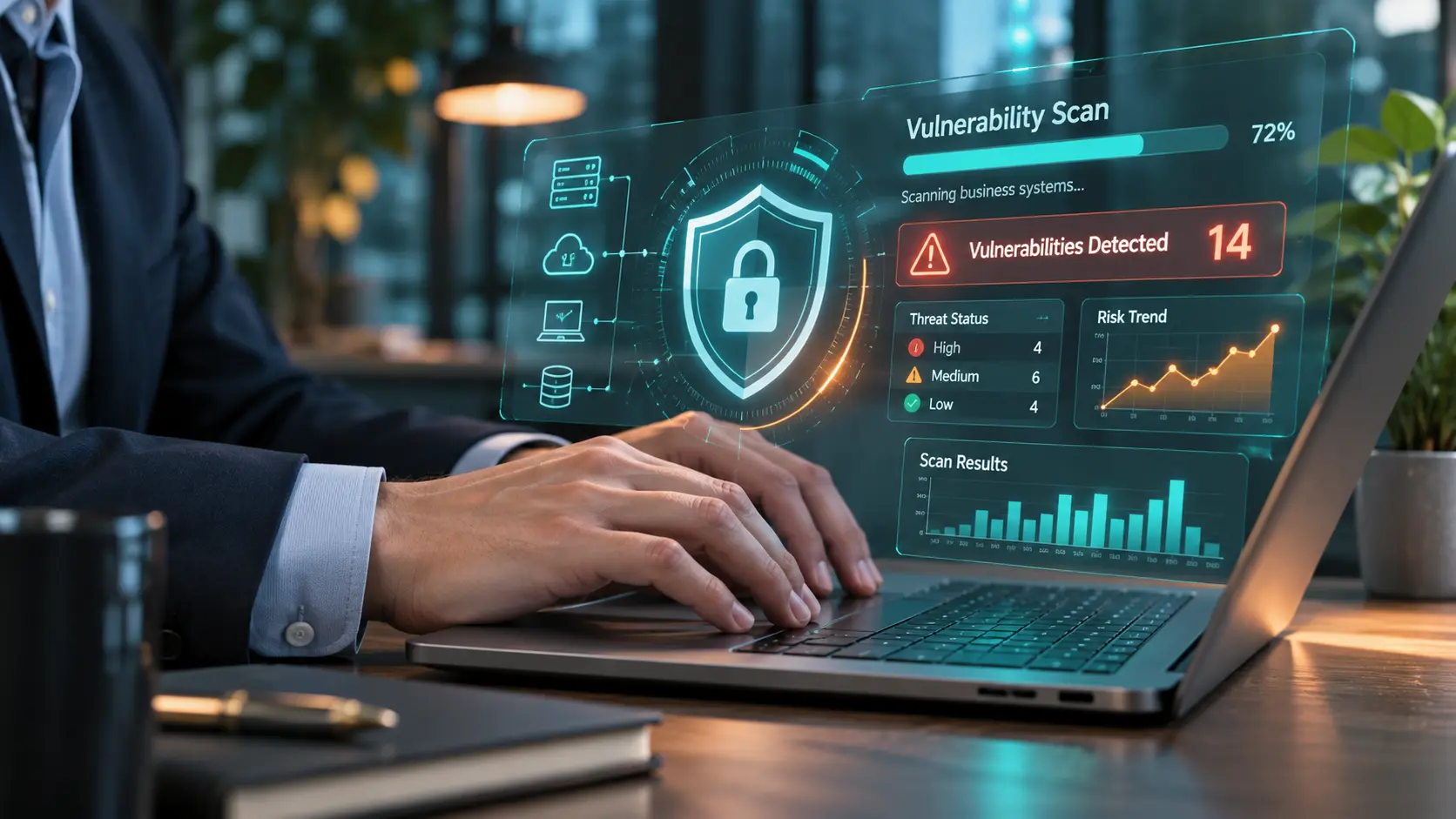
Vulnerability scanning is an automated security-testing process that checks systems for known vulnerabilities, outdated software, exposed services, configuration weaknesses, and other potential security concerns.
Depending on the scope, a scan may examine internet-facing systems, internal network devices, servers, endpoints, or selected applications.
CISA describes its own vulnerability scanning service as recurring testing of internet-accessible assets for known vulnerabilities, weak configurations, configuration errors, and other security concerns.
That same principle is valuable for private organizations: regularly review what is exposed and identify weaknesses before they become harder to manage.
What Can Vulnerability Scanning Services Find?
Vulnerability scanning services can identify a wide range of potential issues depending on the systems being assessed and the scanner's visibility.
Common findings may include:
- Missing software or firmware updates
- Known vulnerabilities associated with installed products
- Unsupported or outdated software
- Exposed network services
- Weak security configurations
- Unexpected open ports
- Older encryption protocols
- Internet-facing administrative services
- Security settings that require review
- Systems that may need additional investigation
A scan does not automatically prove that every finding can be exploited. For this reason, results still need review and prioritization.
Why One Vulnerability Scan Is Not Enough
A scan provides a view of the environment at a particular point in time. Business technology does not remain static after that scan finishes.
New vulnerabilities may be published later. In addition, software updates, new devices, firewall changes, cloud deployments, or configuration changes can alter the organization's risk.
As a result, vulnerability management works better as an ongoing process than as a one-time project.
Recurring scans can help confirm whether new weaknesses have appeared and whether previously identified issues have been addressed.
Vulnerability Scanning Services Help Find Internet Exposure
Vulnerability scanning services can be especially useful for systems that are reachable from the public internet.
External scanning can show what an organization's public-facing environment looks like from outside the network. This may include websites, remote-access services, network equipment, and other internet-accessible technology.
CISA's vulnerability scanning model includes target discovery so organizations can maintain better awareness of active internet-accessible systems.
That visibility matters because a forgotten service may still be reachable even if employees no longer use it.
Internal and External Vulnerability Scanning Are Different
External and internal scans answer different security questions.
External Vulnerability Scanning
External scanning examines systems visible from outside the organization. It can help identify internet-facing services, exposed systems, and known vulnerabilities available from the public network.
Internal Vulnerability Scanning
Internal scanning examines systems from within an authorized network. This can provide visibility into devices and services that are not publicly accessible but may still contain weaknesses.
Depending on the assessment goals, organizations may need one or both approaches.
Authenticated Scanning Can Provide Deeper Visibility
Some vulnerability scans operate only from the network perspective, while others can use approved credentials to inspect systems more deeply.
Authenticated scanning may provide more detailed information about installed software, missing updates, local configurations, and other conditions that are difficult to identify remotely.
In practice, deeper visibility can improve finding accuracy and reduce uncertainty about whether a system is actually affected.
The appropriate scanning method depends on scope, authorization, system sensitivity, and the goals of the assessment.
Why Vulnerability Severity Alone Is Not Enough
Vulnerability findings are often associated with severity ratings, but a number by itself does not tell the whole story.
The FIRST CVSS v4.0 specification separates vulnerability characteristics into Base, Threat, Environmental, and Supplemental metrics.
That distinction is important because the same technical weakness can create different levels of business risk depending on where the affected system is located, what information it handles, and whether exploitation is occurring.
Good vulnerability management combines scanner severity with business context.
Vulnerability Scanning Services Help Prioritize Remediation
Vulnerability scanning services become most useful when findings lead to clear remediation priorities.
Not every issue needs the same response. Some findings may affect internet-facing systems, while others may exist on isolated or lower-risk devices.
Useful prioritization factors may include:
- Technical severity
- Whether exploitation has been reported
- Whether the system is internet-accessible
- The importance of the affected system
- The sensitivity of the data involved
- Existing security controls
- Availability of a patch or mitigation
- Operational impact of remediation
This makes vulnerability scanning part of a larger risk-management process rather than an exercise in counting findings.
Recent Attacker Scanning Shows Why Timing Matters
Attackers also scan the internet looking for vulnerable systems. That means the time between vulnerability disclosure and remediation can matter.
On October 28, 2026, BleepingComputer reported that attackers had begun probing the internet for systems exposed to a recently patched Oracle E-Business Suite vulnerability .
The flaw had received an Oracle security update only days earlier. Reports like this show why organizations need a way to identify affected systems and respond to important vulnerabilities without relying on memory or manual inventory alone.
Scanning and Patch Management Work Together
Finding a vulnerability is only the beginning. Organizations also need a process for deciding how the weakness should be addressed.
NIST's enterprise patch management guidance describes a vulnerability-management lifecycle that includes identifying affected assets, planning a risk response, executing that response, and verifying the result.
In many cases, remediation involves applying a vendor patch. Other situations may require configuration changes, temporary mitigations, system replacement, or additional security controls.
This is why scanning and patch management should support one another rather than operate as separate activities.
Vulnerability Scanning Does Not Replace Patch Management
A vulnerability scanner can identify weaknesses, but it does not automatically fix every problem it finds.
Remediation may require software updates, firmware upgrades, configuration changes, replacing unsupported systems, or adjusting access controls.
SecuraLynx's managed endpoint security services include patch management, vulnerability checks, monitoring, and other controls that can support ongoing device security.
By connecting detection with remediation, businesses can move from simply knowing about vulnerabilities to actually reducing them.
Vulnerability Scanning and EDR Solve Different Problems
Vulnerability scanning and Endpoint Detection and Response are both valuable, but they address different parts of cybersecurity.
Vulnerability Scanning
Scanning looks for known weaknesses and conditions that could increase the chance of compromise.
Endpoint Detection and Response
EDR monitors endpoint behavior and helps identify suspicious activity that may indicate an active or attempted compromise.
SecuraLynx's guide to managed EDR services explains how endpoint monitoring, investigation, and response fit alongside preventive controls.
Vulnerability Scanning Is Not the Same as Penetration Testing
These two terms are often used together, but they are not interchangeable.
Vulnerability scanning relies heavily on automated checks to find known weaknesses across the approved scope.
Penetration testing goes further by using authorized testing techniques to determine whether selected weaknesses can be exploited and what impact that access could create.
SecuraLynx's Advanced Security Assessment can include vulnerability scanning, authorized network or application testing, and compliance-focused gap analysis depending on the selected scope.
False Positives and Validation Still Matter
Automated tools can generate findings that require additional review. A scanner may detect a software version, service, or configuration that appears vulnerable without understanding every detail of the environment.
For that reason, results should be reviewed before major changes are made.
Validation can help determine whether the issue is real, whether compensating controls exist, and whether remediation should be prioritized immediately.
This review process helps turn technical scan output into practical security decisions.
Vulnerability Scanning Services Support Security Monitoring
Vulnerability scanning services provide another source of information that can support broader security monitoring.
For example, a newly identified vulnerability may become more urgent if security monitoring also shows unusual activity on the same system.
SecuraLynx's managed security monitoring services provide visibility across alerts, endpoints, accounts, networks, vulnerabilities, and other security events.
Combining vulnerability data with monitoring can provide more context than either source alone.
Vulnerability Scanning Can Support Compliance Reviews
Many security frameworks and compliance programs expect organizations to identify and manage technical vulnerabilities.
The exact scanning frequency, scope, documentation, and remediation requirements depend on the applicable standard.
Still, maintaining scan reports and remediation records can help demonstrate that the organization has an active process for finding and addressing security weaknesses.
SecuraLynx's Advanced Security Assessment can also include compliance-focused gap analysis for standards such as HIPAA, ISO 27001, PCI DSS, CMMC, CIS, and SOC 2.
How Often Should Vulnerability Scanning Be Performed?
There is no single schedule that fits every organization.
Scan frequency may depend on the number of systems, level of risk, compliance requirements, internet exposure, and how often the environment changes.
Organizations may also perform additional scans:
- After significant infrastructure changes
- After deploying new internet-facing systems
- After major application updates
- When important new vulnerabilities are disclosed
- After remediation to verify findings were addressed
- As part of scheduled cybersecurity assessments
The important part is having a repeatable process rather than relying on an occasional scan with no follow-up.
What Should Vulnerability Scanning Services Include?
Organizations evaluating vulnerability scanning services should consider more than whether a scanner can produce a report.
Useful capabilities may include:
- Clear assessment scope
- External and/or internal scanning
- Identification of known vulnerabilities
- Configuration and exposure review
- Risk-ranked findings
- Manual review of important results
- Remediation recommendations
- Follow-up verification
- Useful technical documentation
- Integration with broader security assessments
The most useful service helps the business understand what was found, why it matters, and what should happen next.
How SecuraLynx Provides Vulnerability Scanning Services
SecuraLynx includes vulnerability scanning within its broader cybersecurity assessment and managed-security capabilities.
Its Advanced Security Assessment can include vulnerability scans, authorized network testing, optional application testing, compliance gap analysis, and a prioritized final report.
SecuraLynx also lists proactive auditing and vulnerability scans as part of its broader Threat Detection & Response services.
This allows vulnerability findings to be considered alongside endpoint security, monitoring, patching, network protection, and other cybersecurity controls.
Frequently Asked Questions
What is vulnerability scanning?
Vulnerability scanning uses automated security checks to identify known weaknesses, outdated software, exposed services, and configuration concerns across systems included in an approved assessment scope.
Does vulnerability scanning fix security problems?
Not by itself. Scanning identifies potential issues. Remediation may require patching, configuration changes, stronger access controls, system upgrades, or other corrective actions.
What is the difference between vulnerability scanning and penetration testing?
Vulnerability scanning primarily uses automated checks to identify known weaknesses. Penetration testing uses authorized testing techniques to determine whether selected weaknesses can actually be exploited and what impact that access could create.
Can vulnerability scans produce false positives?
Yes. Automated findings may sometimes require manual validation. Reviewing important findings helps confirm the actual risk before remediation decisions are made.
How often should businesses scan for vulnerabilities?
Frequency depends on the environment, risk, compliance requirements, and rate of change. Scanning should also be considered after major changes or when important new vulnerabilities affect systems the organization uses.
What are vulnerability scanning services?
Vulnerability scanning services help organizations identify known security weaknesses, exposed systems, outdated software, and configuration issues so findings can be reviewed and prioritized for remediation.
Make Vulnerability Scanning Services Part of Your Security Strategy
Vulnerability scanning services help businesses identify security weaknesses before those issues remain hidden for months or years.
Regular scanning can improve visibility into outdated software, exposed services, configuration concerns, and known vulnerabilities across approved systems.
The strongest approach connects scanning with patch management, endpoint security, monitoring, risk assessment, and follow-up remediation.
Ultimately, finding vulnerabilities is only useful when the results lead to practical security improvements.
Do You Know Which Vulnerabilities Are Exposed in Your Environment?
SecuraLynx can help review your environment through vulnerability scanning, security assessments, technical testing, and prioritized recommendations.
Start with the assessment level that matches your security needs and determine which weaknesses should be addressed first.
Explore Cybersecurity Assessments