Network segmentation for businesses helps restrict unnecessary access, protect sensitive systems, and limit the spread of cybersecurity threats across connected devices and applications.
Network segmentation for businesses is a cybersecurity practice that divides a network into smaller sections and controls how devices, users, and applications communicate between them.
Imagine an employee accidentally downloads a malicious file onto a company computer. If that computer has broad access to other devices, servers, and business resources, the resulting security incident may extend beyond the original device.
A segmented network helps reduce that exposure by creating controlled boundaries between different areas of the organization.
Why Network Segmentation for Businesses Matters
Modern business networks connect employee computers, servers, printers, mobile devices, wireless access points, security cameras, and cloud-based applications.
Not every device needs access to every other system. By limiting unnecessary communication, businesses can reduce opportunities for unauthorized access while maintaining the connections employees actually need.
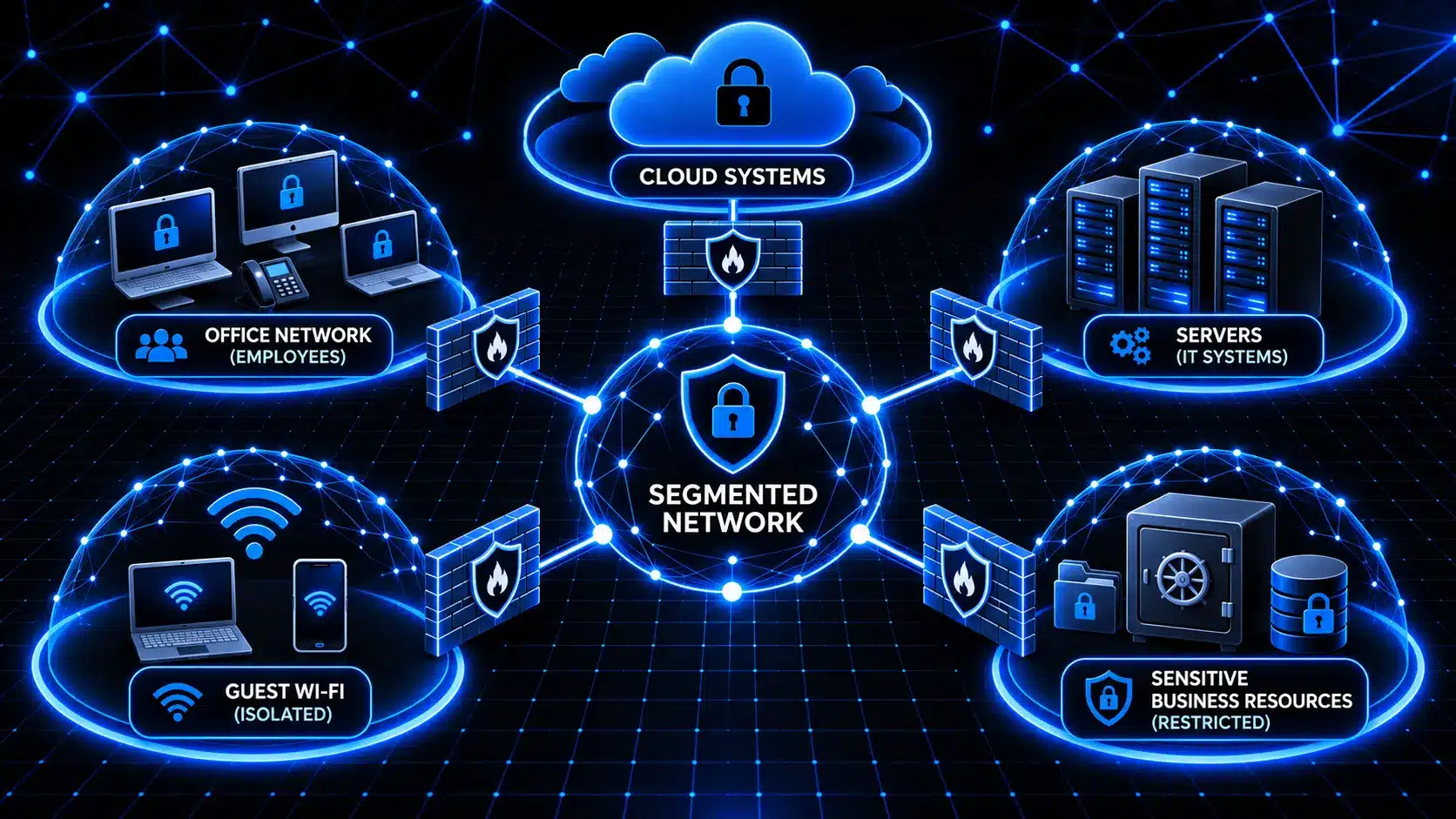
What Is Network Segmentation?
Network segmentation divides a larger network into smaller physical or logical sections. Each section can have its own access requirements, security rules, and authorized connections.
The purpose is to avoid giving every connected device unrestricted access to the entire network.
The MITRE ATT&CK network segmentation guidance identifies physical separation, virtual networks, and controlled communication between systems as ways to reduce unnecessary network exposure.
For example, employee computers may need access to shared documents and business applications, but they do not necessarily need direct access to security cameras or network administration interfaces.
Flat Networks vs. Segmented Networks
Understanding the difference between a flat network and a segmented network helps explain why internal network boundaries are important.
Flat Network
Devices operate within a shared network environment with few internal security boundaries. Depending on the configuration, connected systems may communicate broadly with one another.
- Fewer internal restrictions
- Broader device connectivity
- Greater potential for lateral movement
- More difficult incident containment
Segmented Network
Devices and services are grouped according to business purpose, sensitivity, and access requirements. Communication between groups is controlled.
- Defined network boundaries
- Restricted inter-network access
- Reduced unnecessary connectivity
- Improved containment opportunities
A flat network may appear easier to manage initially. As the organization grows, a properly designed segmented network can provide better control over how systems communicate.
Network Segmentation for Businesses Helps Limit Lateral Movement
Lateral movement describes how an attacker moves from one compromised system to other systems within an environment.
After gaining access to an employee computer, an attacker may attempt to reach additional accounts, file servers, administrative systems, or other business resources.
Network segmentation helps reduce the number of communication paths available for that movement. Properly configured access controls can prevent systems from reaching resources they do not need.
This does not eliminate every attack path. Stolen credentials and legitimate application connections can still create security risks.
For this reason, segmentation should work alongside endpoint protection, identity security, monitoring, and other cybersecurity controls.
How Network Segmentation Helps Reduce Ransomware Risk
Ransomware incidents can affect more than the device where malicious activity first begins. Shared files, connected servers, and other accessible resources may also be at risk.
When network boundaries restrict unnecessary access, a compromised device may have fewer opportunities to communicate with other systems.
For example, an ordinary employee computer should not automatically have unrestricted network access to backup infrastructure, management interfaces, or every server in the organization.
Segmentation can help limit the potential impact of a compromise, while protected backups and effective incident response support recovery.
SecuraLynx's guide to cybersecurity incident response planning explains how preparation, containment, investigation, and recovery fit into a broader response strategy.
How VLANs Support Network Segmentation
A virtual local area network, commonly called a VLAN, allows network administrators to logically group devices using compatible network equipment.
Instead of requiring separate physical switches for every group of devices, VLANs can create distinct logical networks across supported infrastructure.
For example, a business might create separate VLANs for employee computers, guest wireless access, surveillance equipment, and network administration.
Creating VLANs alone does not guarantee effective security. Communication between VLANs must also be controlled through appropriate routing, firewall rules, or access control policies.
Without those restrictions, devices on different logical networks may still have more access than the business intends.
Network Segmentation for Businesses Requires Effective Firewall Rules
Network segmentation for businesses depends on more than placing devices into separate groups. The organization also needs to control which connections are allowed between those groups.
Firewalls and other network access controls can enforce communication policies based on the requirements of each network segment.
A business may allow employee computers to reach a particular application server while blocking direct access to unrelated systems.
As business requirements change, these rules should be reviewed to ensure they remain appropriate.
SecuraLynx's article on managed firewall services explains why ongoing rule reviews, configuration audits, monitoring, and security updates matter.
Which Business Systems Should Be Separated?
The appropriate network design depends on the organization's technology, security risks, and operational requirements.
Common areas to consider include the following:
Employee Workstations
Computers used for everyday business activities need access to approved applications and resources. Unnecessary access to administrative systems should be restricted.
Business Servers and Sensitive Applications
Servers containing financial records, customer information, authentication services, or important business applications may require stronger access restrictions.
Guest Wireless Networks
Visitors generally need internet connectivity rather than access to internal business systems. A separate guest network helps maintain that distinction.
Connected Office Devices
Printers, surveillance cameras, smart devices, and other connected equipment may benefit from access restrictions based on their functions.
Network Administration and Backup Infrastructure
Management interfaces and backup systems often require more restricted access because they can affect critical infrastructure and recovery capabilities.
The objective is not to create as many network segments as possible. Instead, each boundary should serve a clear security or operational purpose.
Guest Wi-Fi Should Not Provide Internal Network Access
Guest wireless access is one of the most familiar examples of network segmentation.
Customers, contractors, and visitors may need to connect to the internet while visiting a business. Their devices do not usually need access to company servers, employee computers, or internal applications.
A separate wireless network with appropriate access restrictions helps reduce unnecessary exposure from visitor devices.
In addition, businesses should confirm that the guest network is actually isolated. Giving it a different network name does not automatically prevent access to internal resources.
Network Segmentation for Businesses Helps Protect Sensitive Data
Sensitive business information may require stronger controls than general office resources.
Financial systems, confidential client records, healthcare information, and intellectual property can have different access requirements.
By restricting network communication according to business need, organizations can reduce the number of systems that are able to reach these resources.
Network restrictions should also work alongside application permissions, strong authentication, encryption, and data security controls.
Together, these protections help reduce unnecessary exposure at multiple levels rather than relying on a single security boundary.
Network Segmentation and Microsegmentation Are Different
Traditional segmentation often separates groups of devices or services into defined network zones.
Microsegmentation applies more granular communication policies to individual workloads, applications, or smaller groups of resources.
Network Segmentation
Creates broader security boundaries between departments, device groups, infrastructure, or other network zones.
Microsegmentation
Applies more detailed controls to communication between individual workloads or application components.
Both approaches aim to restrict unnecessary access. The appropriate level of separation depends on the environment, available technology, and security requirements.
Recent Cybersecurity Guidance Reinforces the Importance of Segmentation
Network segmentation remains an important subject in current cybersecurity guidance.
The Australian Cyber Security Centre published updated networking security guidelines in September 2026 that emphasize segmentation and segregation as effective controls for limiting malicious activity after initial network access.
The guidance highlights a practical security principle: an initial compromise should not automatically give an attacker broad access to the rest of an organization's technology.
Businesses can apply that principle by reviewing internal access requirements and limiting connections that do not serve a legitimate purpose.
Common Network Segmentation Mistakes
A network may appear segmented on a diagram while providing considerably more access in practice.
The Australian Cyber Security Centre's network segmentation anti-patterns guidance examines how ordinary operational changes and growing configuration complexity can gradually undermine intended network boundaries.
Common mistakes businesses should avoid include:
- Creating VLANs without appropriate access restrictions
- Allowing broad communication between network segments
- Leaving temporary firewall exceptions active indefinitely
- Connecting guest networks to sensitive resources
- Providing excessive access to management interfaces
- Failing to document network changes
- Overlooking new or replacement devices
- Assuming network isolation works without testing it
- Failing to review monitoring and firewall logs
Regular configuration reviews and authorized testing can help identify these problems before they undermine the intended security design.
Network Segmentation Needs Ongoing Monitoring
Creating network boundaries is only one part of the process. Businesses also need visibility into the activity occurring within and between those boundaries.
Monitoring can help identify unusual traffic, unexpected access attempts, firewall rule changes, and communication patterns that deserve investigation.
For example, repeated connection attempts from a device group that rarely communicates with a particular server may indicate a configuration problem or suspicious activity.
SecuraLynx's guide to managed security monitoring services explains how network activity and other security information can support broader threat detection and response.
Network Segmentation Works Alongside Endpoint Security
Network segmentation and endpoint security address different aspects of cybersecurity.
Segmentation limits unnecessary communication between systems. Endpoint security focuses on the protection and activity of computers, servers, and other devices.
If an employee computer becomes compromised, endpoint detection may identify suspicious activity on that device. At the same time, network restrictions may help limit the systems it can reach.
SecuraLynx's managed endpoint security services provide additional layers of protection through device management, vulnerability detection, monitoring, patching, and threat response capabilities.
Combining these controls can improve protection without depending entirely on one technology.
Network Segmentation and Zero Trust Security
Zero trust security challenges the assumption that a device or user should automatically be trusted simply because it is connected to an internal network.
Segmentation supports this approach by limiting unnecessary communication between network resources.
Effective access decisions may also consider identity, device security, application permissions, and the sensitivity of the requested resource.
In other words, connecting to the company network should not automatically provide unrestricted access to everything within it.
Segmentation is one component of this broader security approach, not a complete zero trust architecture by itself.
Network Segmentation for Businesses Can Support Compliance
Network segmentation for businesses can support compliance efforts by helping organizations define and restrict access to sensitive systems.
The specific requirements depend on the organization's industry, contractual obligations, and applicable security standards.
For example, a business handling sensitive financial or healthcare information may need to demonstrate that access to important systems is appropriately controlled.
Network diagrams, documented access rules, configuration reviews, and security testing can help provide evidence that relevant controls are being maintained.
Segmentation alone does not establish compliance. Businesses must evaluate it alongside all other applicable requirements.
How to Approach Business Network Segmentation
A practical segmentation strategy should begin with an understanding of the existing environment rather than immediate configuration changes.
The Australian Cyber Security Centre's network segmentation and segregation overview provides decision-makers with guidance for planning and overseeing segmentation initiatives.
Businesses can consider the following steps when evaluating their own networks:
- Identify connected assets. Understand which devices, applications, servers, and services operate within the environment.
- Review communication requirements. Determine which systems need to communicate and why.
- Identify sensitive resources. Prioritize systems containing important business data or administrative capabilities.
- Define appropriate network boundaries. Group resources according to business function, access requirements, and security risk.
- Establish controlled access. Configure appropriate network policies and firewall restrictions.
- Test the design. Confirm that approved services remain accessible and unwanted communication is restricted.
- Maintain and review the environment. Revisit network rules as technology and business requirements change.
Careful planning is important because poorly coordinated changes can interrupt legitimate business applications and network connectivity.
Why Network Segmentation Should Be Reviewed Regularly
Business networks continue to evolve after the initial configuration is complete.
Employees change roles, new devices are introduced, applications move to the cloud, and vendors may need temporary access to selected resources.
Over time, these changes can create exceptions that weaken previously established network boundaries.
As a result, segmentation should be reviewed as part of ongoing firewall management, network maintenance, security assessments, and configuration audits.
Reviews can help confirm whether network access still reflects current business needs rather than outdated requirements.
Signs Your Business Network May Need Better Segmentation
Organizations may not always know whether their internal networks are providing appropriate separation.
Potential warning signs include:
- Most devices share a single unrestricted network
- Guest devices can reach internal business resources
- Employee computers have unnecessary server access
- Security cameras share unrestricted access with workstations
- Administrative interfaces are broadly accessible
- Firewall exceptions are poorly documented
- Former vendors retain unnecessary network access
- Backup infrastructure lacks appropriate access restrictions
- Network diagrams are outdated or unavailable
- Network boundaries have never been tested
These conditions do not automatically indicate a security incident. They can, nonetheless, provide useful starting points for a network security review.
Vulnerability Scanning Can Help Identify Network Exposure
Organizations should understand which systems and services are accessible from different parts of their environment.
Authorized vulnerability scanning and network security testing can help identify exposed services, outdated software, configuration concerns, and potential security weaknesses.
Depending on the assessment scope, testing can also help evaluate whether intended network restrictions are working as expected.
SecuraLynx's article on vulnerability scanning services explains how security findings can be reviewed, prioritized, and addressed through a broader vulnerability management process.
How SecuraLynx Supports Business Network Security
SecuraLynx provides managed network security services that include professionally configured firewalls, switching, Wi-Fi, threat monitoring, and ongoing network support.
These capabilities are relevant to establishing and maintaining controlled communication within a business network.
Regular configuration reviews, monitoring, and firewall management can help organizations evaluate whether network access remains appropriate as their technology changes.
In addition, SecuraLynx offers cybersecurity risk assessments to help identify security weaknesses and prioritize improvements according to the organization's needs.
The appropriate segmentation design and implementation scope should be determined through a review of the existing network and business requirements.
Frequently Asked Questions
What is network segmentation for businesses?
Network segmentation for businesses divides a network into smaller sections and controls communication between them. It helps limit unnecessary access, protect sensitive resources, and reduce opportunities for attackers to move between systems.
Can network segmentation stop ransomware?
Segmentation cannot prevent every ransomware attack. It can help restrict communication paths and limit the potential spread of malicious activity. Businesses should also maintain endpoint security, protected backups, monitoring, and incident response procedures.
Is a VLAN the same as network segmentation?
A VLAN is one technology used to create logical network segments. Effective security segmentation also requires appropriate controls that restrict communication between those segments.
Should guest Wi-Fi be separated from internal networks?
Yes. Guest devices generally need internet connectivity rather than access to internal business systems. Appropriate network isolation helps reduce unnecessary exposure from visitor devices.
Does network segmentation affect performance?
A properly planned design may help manage network traffic and reduce unnecessary communication. Poorly designed rules or insufficient network capacity can also affect performance. Businesses should test important applications before and after significant configuration changes.
How often should network segmentation be reviewed?
Network segmentation should be reviewed periodically and after significant changes involving devices, applications, remote access, infrastructure, or business requirements. The appropriate frequency depends on the environment and its risks.
Does network segmentation replace endpoint security?
No. Segmentation controls communication between network resources, while endpoint security focuses on protecting devices. Both contribute to a layered cybersecurity strategy.
Make Network Segmentation for Businesses Part of Your Security Strategy
Network segmentation for businesses helps organizations establish meaningful boundaries between devices, applications, and sensitive resources.
By restricting unnecessary communication, businesses can reduce opportunities for lateral movement, improve access control, and support incident containment.
Effective segmentation requires more than an initial configuration. Firewall rules, monitoring, testing, documentation, and regular reviews all play important roles in maintaining those boundaries.
A well-managed network should provide employees with the connectivity they need without exposing unrelated systems and resources unnecessarily.
Ultimately, network segmentation works best as part of a broader cybersecurity strategy that includes endpoint security, identity protection, vulnerability management, backups, and incident response.
Is Your Business Network Properly Segmented?
SecuraLynx can help review your network configuration, firewall rules, wireless infrastructure, and access controls to identify potential security gaps.
Protect sensitive business resources, reduce unnecessary network access, and strengthen your cybersecurity strategy with professionally managed network security.